

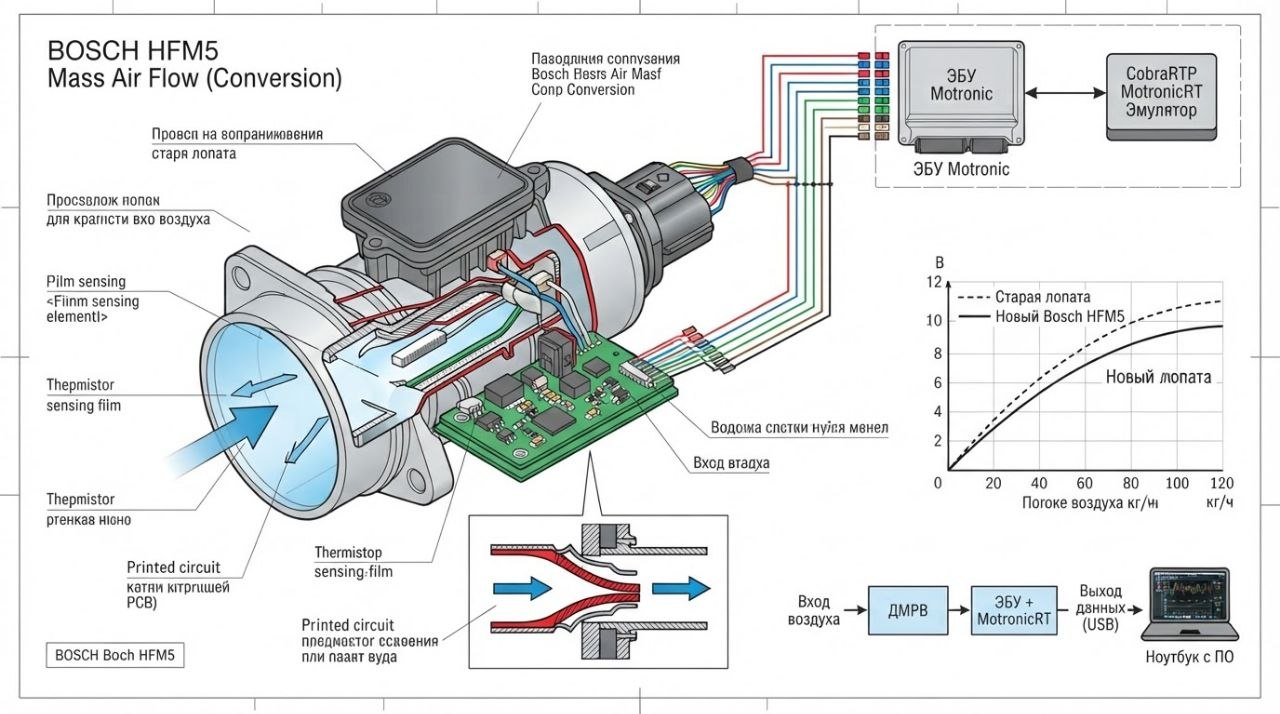
Owners of cars from the 80s and 90s with control systems Bosch Motronic and Jetronic (BMW E30/E34/E36, Volvo, Audi 80/100, Opel, VW) sooner or later face the need to replace the stock air flow meter. There are two reasons: either the old mechanical "shovel" (or the early threaded sensor) has completely worn out, or during engine modifications (installation of a turbo, compressor, or stroker kit), the stock MAF has reached its air flow limit (5 volts) and is preventing boost pressure from increasing.
The solution is obvious: install a modern film MAF sensor (for example, a Bosch HFM5 of the required diameter). Physically screwing the sensor in and re-pinning the connector can be done in an evening. But then comes the main stage— calibration of the new sensor in the firmware for a specific engine configurationIt's at this stage that most projects stall for weeks. We'll explore why this happens and how to set it up online with an emulator. MotronicRT allows you to roll out a new flow meter in just in one hour.
What's the problem: why can't we just install a different flow meter?
For the ECU, any MAF sensor is simply a voltage source ranging from 0 to 5 volts. To help the brain understand exactly how many kilograms of air passed through the intake at a specific voltage, the firmware stores calibration table.
- The curves of the old "shovel" and the modern film sensor are completely different.
- Even if you use the factory calibration from the donor sensor, your intake tract has different hoses, a different filter, and different pipe geometry. A 10-15% error is guaranteed, which results in a fluctuating idle, dips, and an incorrect mixture under load.
To ensure the engine runs like factory (or safely holds boost), you need to run this table for your specific intake using a wideband lambda probe (WBO).
Why does it take days (or even weeks) the old-fashioned way?
If you set up the MAF calibration in the classic way using a regular ROM chip programmer (27C256 / 27C512), the process turns into an endless Groundhog Day:
- Write the basic calibration into the chip and install it into the ECU.
- Start the car, drive onto the road and record the mixture log using the fuel gauge.
- You can see that at 2.4 V the mixture is lean, and at 3.2 V it is rich.
- Turn off the engine, go to the control unit, disassemble it, and pull out the microcircuit.
- If the chip is UV-erasable, place it under an ultraviolet lamp for 15–20 minutes (or get a new disposable chip).
- Correct the firmware points, flash the chip with a programmer, assemble the ECU, and install it in the car.
- Start it again and go check it out.
It takes time to select just the idle speed and transient mode calibrations 15–20 such cyclesAt best, this stretches on several days hard work, and the pins of the microcircuit and the socket in the ECU have time to suffer considerably during this time.
How it works with MotronicRT: from start to perfection in 1 hour
Online ROM emulator MotronicRT It is installed instead of the standard memory chip and allows you to change the ECU calibrations directly on a running engine in real time. The entire process of switching to a different MAF sensor is 60 minutes:
- Step 1. Start in 5 minutes. You load the base curve of the new sensor into the emulator memory directly from the laptop (via TunerPro RT) and start the engine. No programmers or extra chips required.
- Step 2. Live Tracing of Tables. The laptop screen highlights the exact MAF calibration cell the engine is currently running in in real time. You can immediately see: "So, at idle, the sensor reads 1.15 V, the mixture is 13.2 V—it needs to be turned down a bit."
- Step 3. Editing on the fly in 40 minutes. You (or a partner with a laptop) press a couple of keys on the keyboard, changing the value at the desired point - and the engine at the same second It reacts to changes by equalizing the mixture using the throttle body. You simply smoothly cycle through all modes: idle, low loads, acceleration, and full throttle (including the boost zone if the engine is turbocharged).
- Step 4. Finish without re-soldering. Once the MAF curve has been rolled out across its entire range, the setup is complete. Non-volatile memory MotronicRT Retains the firmware even after the battery is disconnected. The emulator remains inside the ECU as a reliable, permanent chip.
The main advantages of this approach
- Saving time and nerves. Instead of spending several days in the garage with a soldering iron and a UV lamp, you get a fully tuned intake in one evening out.
- Accuracy up to tenths of a mixture. In real time, you can fine-tune the transient modes so that the car will start in any frost and move off smoothly without a single failure.
- Ready for further tuning. We decided to install more efficient injectors in a month, increase the boost pressure, or implement launch control via the function Dual-Mode? Connect your laptop, and everything is fixed again in minutes.

 Русский
 English (UK)
 Français