

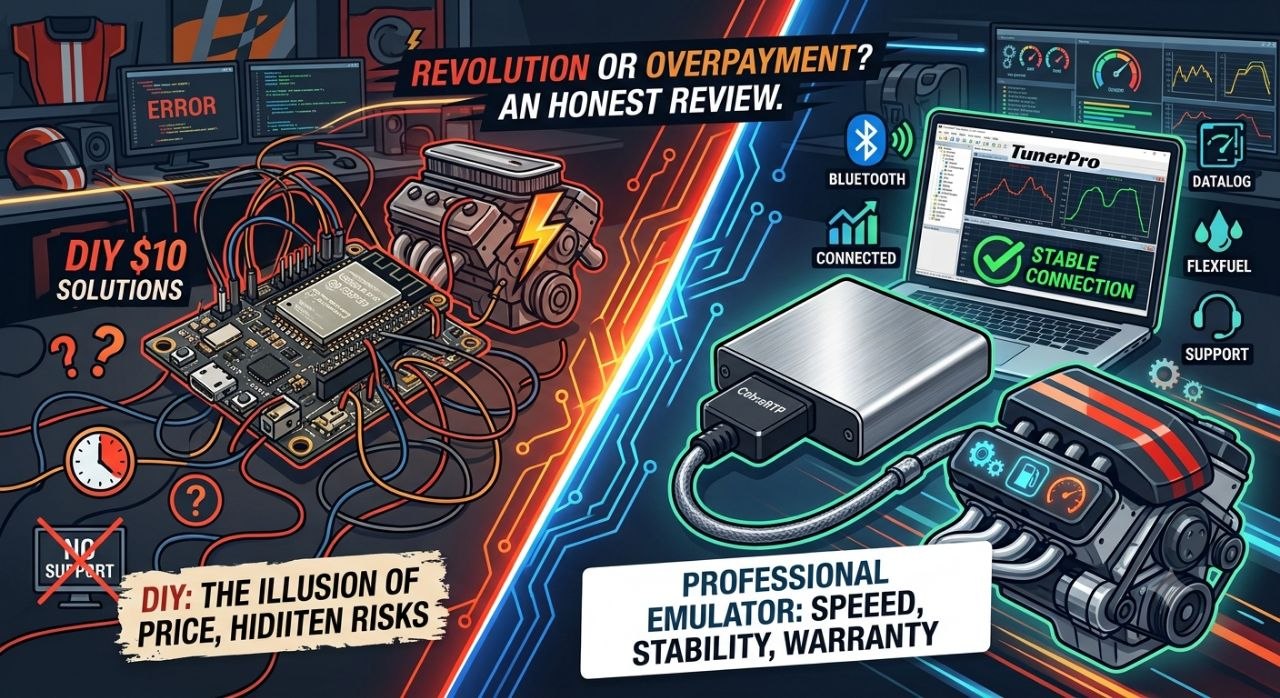
The world of chip tuning and online tuning sees periodic "revolutions." Amateur DIY projects like OneROM and similar solutions based on inexpensive controllers (e.g., Raspberry Pi Pico / RP2040) appear, which hobbyists adapt to emulate ECU memory. At first glance, these seem like a killer for commercial products. Why pay more when a "$10 piece of hardware" does the same thing?
Let's break down why a professional emulator (like CobraRTP) isn't just a brand overpayment, but a must-have for anyone who values their time, engine, and safety.
1. Price Illusion: $10 Turns into Hidden Costs
The main argument of DIY proponents is price. But let's do the math:
- Cost of components: The board itself costs $10. You'll need to purchase high-quality wires, shielded cables, adapters, and a housing (to prevent the board from accidentally shorting to the ECU ground while driving).
- Hidden time wasters: How many hours will you spend soldering, programming the controller itself, searching for pinout diagrams, and fixing assembly errors? If you convert your personal time into money, a "penny" project quickly catches up with the cost of the finished product.
- Risk of burning the ECU: One accidental misconnection or short circuit on a homemade board and you're buying new "brains" for the car, which wipes out all the savings.
2. Technical justification: Hardware and Software
A professional emulator is not just a memory chip soldered to a USB adapter using some hacks.
- Speed and stability: CobraRTP is based on powerful 32-bit processors and non-volatile NVRAM memory. This ensures instant loading of calibrations on the fly, without communication lag. DIY projects often use slow or unstable data buses, which can cause software (such as TunerPro) to freeze at the most crucial moment of the test bench cutoff.
- Additional functionality: The CobraRTP has Bluetooth out of the box (no cables running through the cabin under the hood), data logging support (Datalog), and inputs for a wideband lambda probe (WBOS) and FlexFuel sensors. DIY kits for $10 don't have these features—you'll have to build several third-party boards on top.
- Integration with software: Professional products have official support and plugins in TunerPro RT, Chrome, and eCtune. DIY projects often require hacks, third-party conversion utilities, and specific drivers that break after every Windows update.
3. Open Source and Bugs: Nobody Owes You Anything
The biggest problem of the DIY segment is status Open Source or the developer's personal hobby.
- Bugs that don't need to be fixed: Found a critical bug that causes the emulator to lose connection at 5000 RPM or incorrectly emulate memory timings? An open-source project developer (who has a full-time job, family, and other responsibilities) might not release updates for years. You're left alone with your problem, since the project is distributed "as is."
- Enthusiasm Dependence: Once a DIY circuit creator gets bored with their hobby, the project simply dies. You won't get patches for new Windows versions or updated configuration software.
4. Technical Support and Quality Assurance: Business vs. Lottery
What happens when a DIY project fails to launch or loses connection? You turn to a forum or chat, where, at best, you'll get the following answer: "Everything works for me, look for the problem in your wiring.".
- Full technical support: Commercial products have live and ongoing support. If the emulator is unavailable, specialists will help isolate the problem or update the device's firmware remotely.
- Quality assurance: A professional device undergoes factory testing (QC) before sale and is protected by an official warranty. If the board fails through no fault of your own, it will be replaced. A DIY project is always a gamble with no obligations.
5. Documentation and Manuals: Opened, read, configured
$10 projects usually come with a text file. readme.txt Three lines and a couple of blurry photos of the wiring diagram. A forced quest through forums and chats is guaranteed.
CobraRTP offers:
- Detailed step-by-step manuals with high-quality diagrams.
- Clear instructions for integration into specific types of ECUs (where to solder the socket, which jumpers to cut).
- A database of ready-made profiles and definition files (XDF) for software.
6. Legality and licensing purity
By purchasing a commercial product, you're acquiring a legitimate device with official software and drivers that won't be blocked by the next system update. DIY projects often teeter on the edge: they use "gray" reverse engineering techniques, steal chunks of other people's code, or exploit software vulnerabilities for configuration, making them unstable and legally unsafe for commercial tuning.
7. Manufacturer's Liability: The Price of Getting Stuck
ECU tuning is about controlling the mixture and ignition timing. A hardware failure here is equivalent to engine failure.
- If the $10 DIY freezes: The cheap board loses connection on the highway or under boost, the ECU goes crazy, the engine detonates and breaks down. The author of the online circuit diagram I don't give a damn at all - You installed the homemade product at your own risk.
- Brand Responsibility: CobraRTP, the manufacturer, stands behind its hardware with its reputation. The board is designed to meet automotive standards: it's protected from interference and power sags, and physically cannot freeze in a way that could destroy the motor.
- Business risks: A DIY board failure on a customer's machine will instantly ruin your reputation as a tuner and leave you responsible for repairing someone else's motor. With a commercial product, you're protected by the manufacturer's ironclad reliability.
Result
A $10 emulator is good as an academic experiment—assemble it on a table, blink the LEDs, and understand how the emulation protocol works.
But if your goal is - customize a real car Whether you're looking for a reliable solution (either your own or a client's), get consistent results, and avoid going gray in the process, the choice is clear. A professional solution pays for itself on the very first day of work thanks to time saved, a stable connection, and safety for the car's electronics.

 Русский
  English (UK)
  Français